


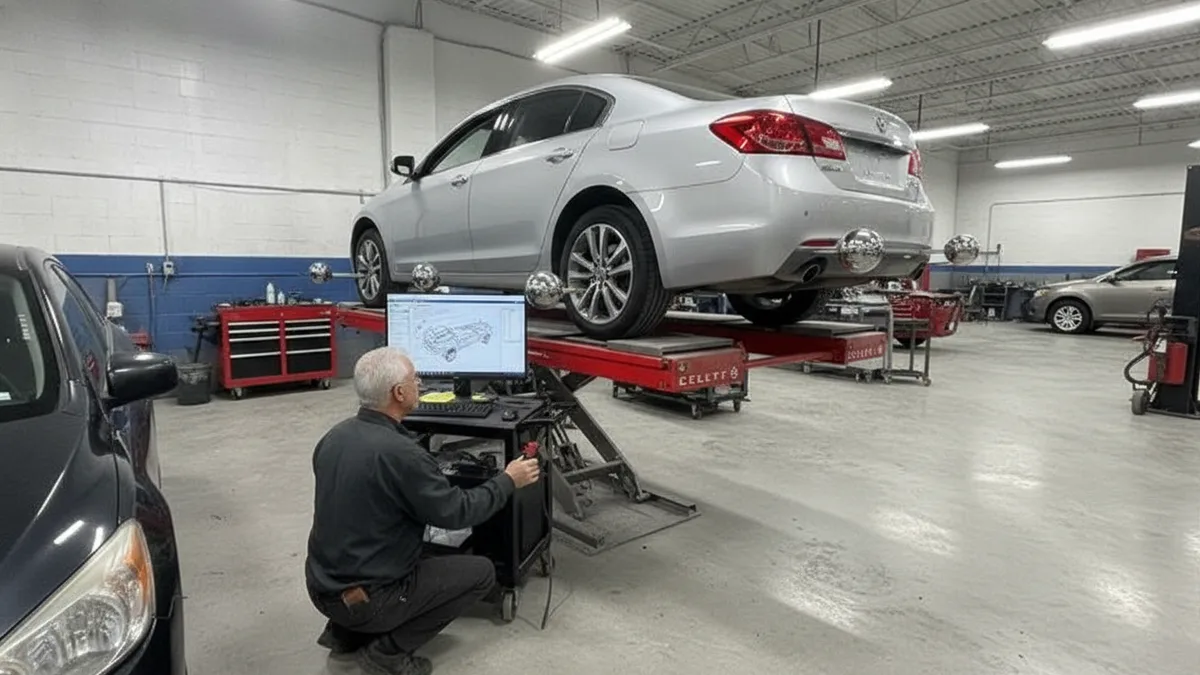
Understanding Frame Alignment: Why It Matters After a Collision in Queens, NY — A Guide to Certified Collision Repair
What Frame Misalignment Is and Why Collision Impact Causes It
Frame misalignment happens when a collision bends, twists, or shifts a vehicle’s structural frame out of the factory specifications set by the manufacturer. For drivers in Queens, NY, USA, this matters because a misaligned frame can compromise handling, tire wear, airbag timing, and how the vehicle absorbs impact in a future accident. ANA Auto Repair evaluates frame alignment as a standard part of collision assessment, not an add-on.
Picture a fender bender on a side street in South Ozone Park. The bumper looks fine, maybe a small dent, and the driver assumes the damage is cosmetic. Under the surface, though, the force from that impact travels through the frame rails and unibody structure, sometimes bending metal in places a visual inspection will never catch. Cars are engineered to absorb crash energy along specific paths, called crumple zones, so the metal folds and flexes in predictable ways to protect passengers. When that energy hits the frame at an angle, or when the impact speed exceeds what those zones are built for, the structure can shift a few millimeters out of true. That small shift is enough to throw off steering geometry and stress mounting points for the suspension.
Here’s the tricky part. Minor impacts often produce hidden frame problems that look like nothing from the driver’s seat. A car might still drive straight for a while before uneven tire wear or a pull to one side shows up weeks later. ANA Auto Repair has been serving Queens since 1994, and in our experience, the vehicles that come back with unresolved handling complaints are almost always ones that skipped a proper frame measurement the first time around. Anyone weighing repair options can review the full range of collision and frame repair services ANA Auto Repair offers before deciding how to proceed after an impact.
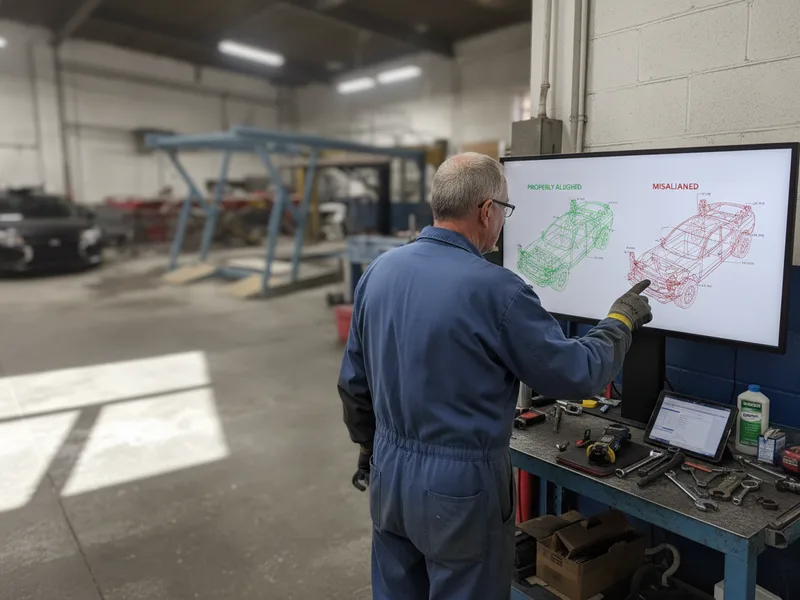
How Collision Forces Damage Frame Alignment
Physics doesn’t care how fast you were going. A collision sends energy through the frame in a split second, and that energy has to go somewhere. It travels along the rails, through the crumple zones, and into whatever structural member happens to be in its path. The result is bending, twisting, or shortening at the point of impact, and often well beyond it.
Front-end collisions push the frame rails backward and can force them to buckle upward or downward depending on the angle of the hit. A straight-on impact tends to compress the frame evenly, but almost no real-world crash is perfectly straight on. Most involve some angle, which means one rail absorbs more force than the other. That uneven load twists the frame instead of just compressing it, and a twisted frame is much harder to spot by eye than a dented bumper.
Side-impact hits work differently. The force comes in perpendicular to the frame’s design, which means the structure wasn’t built to resist it the same way. A T-bone collision, even at lower speeds, can shift the frame laterally at the point of contact while the rest of the vehicle’s mass keeps moving. That shear force can rack the frame, meaning one side shifts forward or backward relative to the other. You won’t always see this in the sheet metal.
Here’s the part most drivers don’t expect: a “small fender bender” can hide a lot of frame damage. In our experience at ANA Auto Repair, a bumper that looks barely scratched can still transfer enough force into the frame rail behind it to knock the whole structure out of spec by a measurable amount. Bumpers and fascias are designed partly to absorb impact, so they can look rough while doing their job, or look fine while the frame behind them took the real hit.
This is why eyeballing a car after a collision doesn’t tell the whole story. Frame damage isn’t always visible from the outside, and guessing at it isn’t a safe approach. It takes laser or computerized measuring equipment, checked against factory specifications, to know whether a frame is true. That kind of measurement is standard practice at a certified collision repair center, and it’s a step we don’t skip regardless of how minor the damage looks. If you’re weighing a repair decision after an accident in Queens, NY, USA, a full measurement is worth asking about before anyone signs off on “cosmetic only” damage.
The Safety and Performance Consequences of Misaligned Frames
Techs who’ve spent years pulling frames notice the same pattern over and over. A customer drives in convinced their car is fine because it “handles a little different” but nothing feels broken. Then the alignment readings come back off by a margin that would concern any trained eye. That gap between “feels okay” and “measures okay” is where the real risk lives.
A frame that’s out of specification changes how weight sits on each wheel. That uneven weight distribution wears tires faster on one side, pulls steering slightly off center, and can make braking less predictable, especially in wet conditions common around Queens, NY, USA during the colder months. Drivers covering routes between Ozone Park, Howard Beach, and Richmond Hill put a lot of miles on their vehicles, and small handling issues compound over repeated highway and stop-and-go driving.
Here’s the bigger concern. Crumple zones are engineered to collapse in a specific sequence during impact, absorbing energy before it reaches the passenger cabin. A misaligned frame can throw that sequence off entirely. If a second collision happens, and unfortunately a lot of them do happen to Queens drivers navigating dense traffic, a car with an unaddressed frame problem may not protect occupants the way its original design intended.
In our experience, “the car still drives fine” is one of the most misleading phrases in this business. Plenty of structurally compromised vehicles drive smoothly right up until the moment they don’t. That’s precisely why insurance companies and a certified collision repair center both treat frame alignment checks as non-negotiable steps after any moderate to severe collision, not an optional add-on.
None of this replaces a hands-on inspection. If you have concerns about handling, tire wear, or braking after a collision, it’s reasonable to have a qualified technician measure the frame directly rather than relying on how the vehicle feels from the driver’s seat. For general guidance on vehicle safety standards, resources like the National Highway Traffic Safety Administration are a useful starting point.
Why Modern Alignment Technology Requires Certified Facilities
Frame repair isn’t guesswork anymore. Vehicles built in the last decade use combinations of steel, aluminum, and high-strength alloys that respond differently to heat, pressure, and welding techniques. A shop that treats every frame the same way is going to run into trouble on at least some of the cars that come through the door.
This is where certification stops being a marketing term and starts being a practical requirement. ANA Auto Repair is an I-CAR certified auto body shop and an I-CAR certified aluminum welding center, which means our technicians have gone through structured training on how different frame materials behave under stress and how they need to be repaired. Aluminum, in particular, demands different welding equipment and technique than steel. Treat it like steel, and the repair won’t hold up the way the manufacturer intended.
Being a PPG authorized paint center rounds out that picture. Frame work and paint work aren’t separate jobs; a car that’s been pulled back into shape still needs a finish that matches factory specifications, and that takes training on both ends.
In our experience, drivers sometimes assume any body shop with a lift and a welder can handle frame work. On paper, that might be true. In practice, a shop without ongoing certification training is working from older knowledge, and vehicle designs change often enough that “older knowledge” can mean a repair that looks fine but doesn’t perform the way it should in a future collision.
For Queens drivers comparing shops, certification is one of the few things you can actually verify before handing over your keys. Ask what certifications a shop holds, not just whether they “do frame work.” If you’re in South Ozone Park or the surrounding neighborhoods, our South Ozone Park location page has details on our certifications and services if you’d like to look into it before scheduling anything. A qualified technician should be able to explain, plainly, why a particular repair method is being used on your specific vehicle.
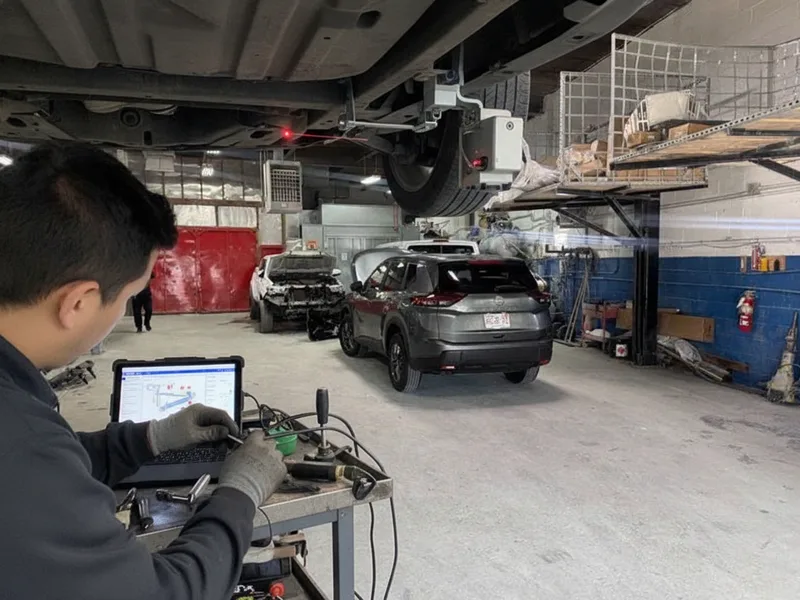
What to Expect During a Frame Alignment Assessment in Queens
Most drivers who walk in after a collision have the same question. How long is this going to take? Fair question. The honest answer is that it depends on the vehicle and the damage, but the assessment process itself follows a consistent path regardless of what pulled into the bay.
It starts with a visual inspection. A technician walks the car, checking panel gaps, door alignment, and obvious signs of impact before anything gets hooked up to equipment. This step alone tells a trained eye a lot, though it’s never the whole story.
From there, the vehicle goes onto an alignment rack, where it gets measured against the manufacturer’s factory specifications using a 3D measuring system. This is where guesswork ends. The scan captures precise reference points along the frame and compares them to what the vehicle looked like before it ever left the factory floor. Any deviation shows up as a measurable number, not a hunch.
Once the scan is complete, the technician reviews the comparison data and puts together a written report. This documents where the frame sits relative to specification and what repair work would bring it back into alignment. In our experience, customers appreciate having this in writing more than almost anything else in the process; it gives them something concrete to review, share with an insurance adjuster, or simply hold onto.
Same-day estimates are possible for frame damage evaluation because the diagnostic tools do the heavy lifting quickly. The visual check, the rack placement, and the 3D scan don’t require days of waiting. What takes longer is the actual repair, if one is needed, since that depends on parts availability and the extent of structural work involved.
ANA Auto Repair, located in South Ozone Park, welcomes walk-ins from drivers across Queens, NY, USA who want a straightforward look at what their frame assessment actually found.
Common Red Flags: When to Insist on a Second Opinion
Not every shop that says it does frame work actually does it well. Here’s what should make you pause.
No written frame report. If a shop tells you the frame is fine but won’t hand you the printout or measurement data to back it up, that’s a problem. A legitimate assessment produces documentation you can keep, show your insurer, or bring to another shop for comparison.
An estimate that’s vague or unusually low. Frame and unibody repair involves diagnostic time, specialized equipment, and often OEM parts. A number that seems too good to be true, without a breakdown of labor and parts, deserves a second look before you commit.
Reluctance to show diagnostic imaging. Shops using computerized measuring systems can pull up before-and-after readings on screen. If a shop hesitates or gets vague when you ask to see this, ask why.
No mention of I-CAR training or aluminum welding certification. Modern frames mix steel and aluminum, and repairing them safely requires specific training on each material. A shop should be able to explain its certifications without you having to dig for it.
No warranty on structural work. Frame and unibody repair is not the place to skip a warranty conversation. If a shop won’t put anything in writing about what’s covered, that’s worth questioning.
In our experience, the shops that hesitate on any of these points usually aren’t hiding something malicious, they’re just cutting corners somewhere. Either way, a second opinion from a certified collision repair center costs you little and protects you a lot. Trust your gut, and don’t feel awkward asking hard questions.
Why ANA Auto Repair’s Frame Alignment Expertise Matters to Queens Drivers
Techs who’ve worked frame jobs for decades can usually tell within the first few minutes whether a shop takes alignment seriously or just wants the car through the bay fast. The clues show up in the equipment on the floor, the paperwork handed over, and whether anyone bothers explaining the readings instead of just saying “you’re good.”
ANA Auto Repair has been doing this work in South Ozone Park since 1994. That kind of tenure isn’t a marketing line; it means the shop has repaired vehicles through decades of changing frame materials, from older steel unibodies to today’s mixed-metal and aluminum structures. Drivers from Ozone Park, Howard Beach, Lindenwood, South Jamaica, Rochdale Village, Richmond Hill, and Jamaica bring in vehicles for the same reason: they want a shop that treats frame work as a precision process, not a formality.
As an I-CAR certified auto body shop and I-CAR certified aluminum welding center, ANA Auto Repair trains specifically for the alloy and welding challenges modern frames present. Being a PPG authorized paint center rounds out the picture once structural repairs are done and the vehicle needs refinishing that matches factory color and texture. For drivers navigating insurance after a collision, the shop’s standing as a Geico Xpress repair shop and part of the Allstate good hands repair network can simplify some of the back-and-forth, though every driver retains the right to choose their own repair shop regardless of what an insurer initially suggests.
Anyone weighing options can review the shop’s background, certifications, and history on the shop’s credentials and company history page before deciding. ANA Auto Repair offers same-day estimates and welcomes walk-ins for drivers who’d rather get eyes on the damage than wait on a callback. For anything involving safety systems or insurance claims, confirming details directly with the shop and a qualified adjuster is always a reasonable step.
Frequently Asked Questions
Can frame alignment be fixed without replacing the frame?
In most cases, yes. Frame-straightening equipment used today can pull a bent or shifted frame back to factory specs without swapping out the whole thing. That said, some damage is too severe for straightening alone, especially if the impact hit multiple points on the frame. When you bring your car to a certified collision repair center in Queens, NY, the shop should measure the damage and walk you through exactly which repair method fits your car.
How long does frame alignment repair typically take?
It really depends on how bad the damage is. A minor alignment issue might get sorted in a day or two, while a car with more serious structural damage could sit in the shop for a week or longer. At ANA Auto Repair, we give same-day estimates so you’re not left guessing, and we start working with your insurance company right away to avoid delays.
Will my insurance cover frame alignment repairs?
Frame alignment and structural repair are standard parts of collision coverage, so yes, your insurer typically covers this once the damage is documented and the claim gets approved. ANA Auto Repair works directly with major carriers, including Geico and Allstate, which cuts down on paperwork headaches and back-and-forth calls. If you’re unsure what your specific policy covers, it’s worth checking with your insurance agent directly before repairs begin.
What’s the difference between OEM and aftermarket parts for frame repair?
OEM parts come straight from your vehicle’s manufacturer and match the exact specs your car was built with. Aftermarket parts are made by other companies, usually cost less, but quality can vary quite a bit from part to part. A certified collision repair center should sit down with you, explain both options for your specific vehicle, and be upfront about how each choice affects your warranty coverage.
Should I be concerned if my car ‘feels fine’ after a minor collision?
Honestly, yes, a little concern is warranted. Frame damage doesn’t always show up behind the wheel; you might drive around for weeks before noticing uneven tire wear, pulling to one side, or other handling issues. That’s because alignment problems often need precise measuring tools to catch, not just a test drive. Even after a low-speed fender bender, getting a proper frame inspection is a smart move, and a licensed technician can tell you for certain whether anything’s off.
Get Your Frame Checked Before It Becomes a Bigger Problem
A bent or misaligned frame doesn’t always show obvious signs, but it can affect how your car handles and how it protects you in another impact. If your vehicle’s been in a collision, ANA Auto Repair in South Ozone Park can pull it up on the rack and give you a straight answer about what’s going on underneath.
Stop by our shop or give us a call for a free, same-day estimate. Our I-CAR certified technicians will walk you through what they find and what your options are, and for anything involving your vehicle’s safety, it’s always worth getting a second opinion too. Take a look at our full collision repair and service menu to see how frame alignment fits into the bigger picture of getting your car road-ready in Queens, NY.
Not sure who to trust with the work? You can check out our reviews on Google and hear directly from other Queens drivers we’ve helped.