


Expert Frame Alignment and Collision Repair Services in Richmond Hill, Queens
Why Frame Damage Is More Serious Than It Appears
A Richmond Hill driver pulls onto Woodhaven Boulevard after a low-speed rear collision. The bumper looks dinged, maybe a cracked tail light. Nothing dramatic. But three weeks later, the car is pulling left, the trunk won’t close flush, and the tires are wearing unevenly. What felt minor at the scene was anything but.
That’s the problem with frame damage. It hides.
Unlike a dented quarter panel or scratched paint, structural damage to a vehicle’s frame or unibody doesn’t announce itself clearly. The forces involved in a collision, even one at moderate speed, travel through the vehicle’s structure in ways that bend, compress, or twist metal far from the actual point of impact. You might see a crumpled front bumper and miss the fact that a frame rail shifted two millimeters out of spec.
Two millimeters doesn’t sound like much. It can throw off your wheel alignment, stress your suspension geometry, and in a subsequent collision, compromise how the vehicle absorbs impact energy. The NHTSA’s crashworthiness research consistently shows that vehicles with unrepaired structural damage perform measurably worse in subsequent crashes.
Here’s an opinion that may surprise you: many shops that seem perfectly capable of cosmetic repair are not equipped to diagnose hidden frame damage accurately. A shop without laser measuring systems or computerized frame analysis is essentially guessing. And a good-looking repair that leaves the frame out of spec is, frankly, worse than leaving the car unrepaired, because it gives drivers false confidence.
Proper frame alignment requires specialized equipment, trained technicians, and certification credentials that matter. As a certified collision repair center based in Queens and regularly serving customers throughout Richmond Hill, ANA Auto Repair has handled these cases since 1994. Our I-CAR certifications and aluminum welding expertise exist precisely because this work demands more than general mechanical skill.
Structural integrity isn’t optional. It’s the baseline everything else depends on.
How Modern Frame Alignment Technology Works
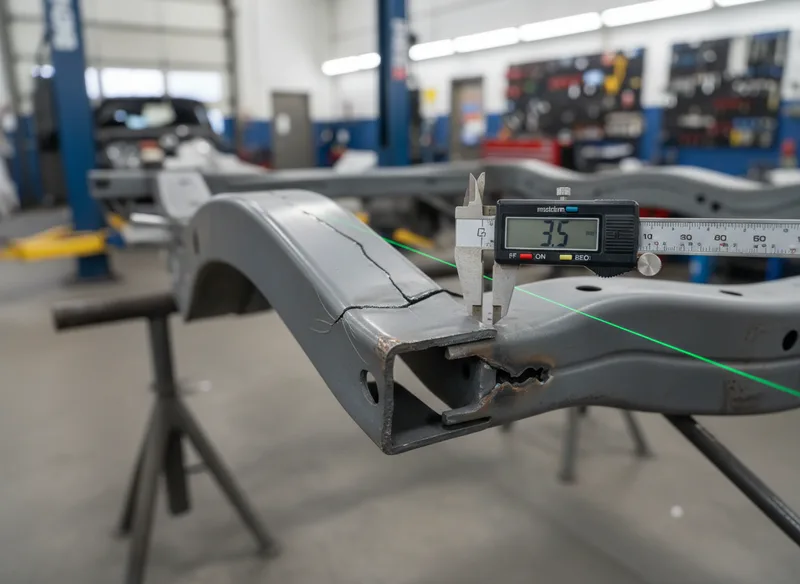
A lot of shops still rely on visual inspection and a tape measure to assess frame damage. That’s not good enough. The human eye can’t detect a 3-millimeter deviation in a unibody rail, but that deviation can throw off your suspension geometry, accelerate tire wear, and compromise how your vehicle responds in a future collision.
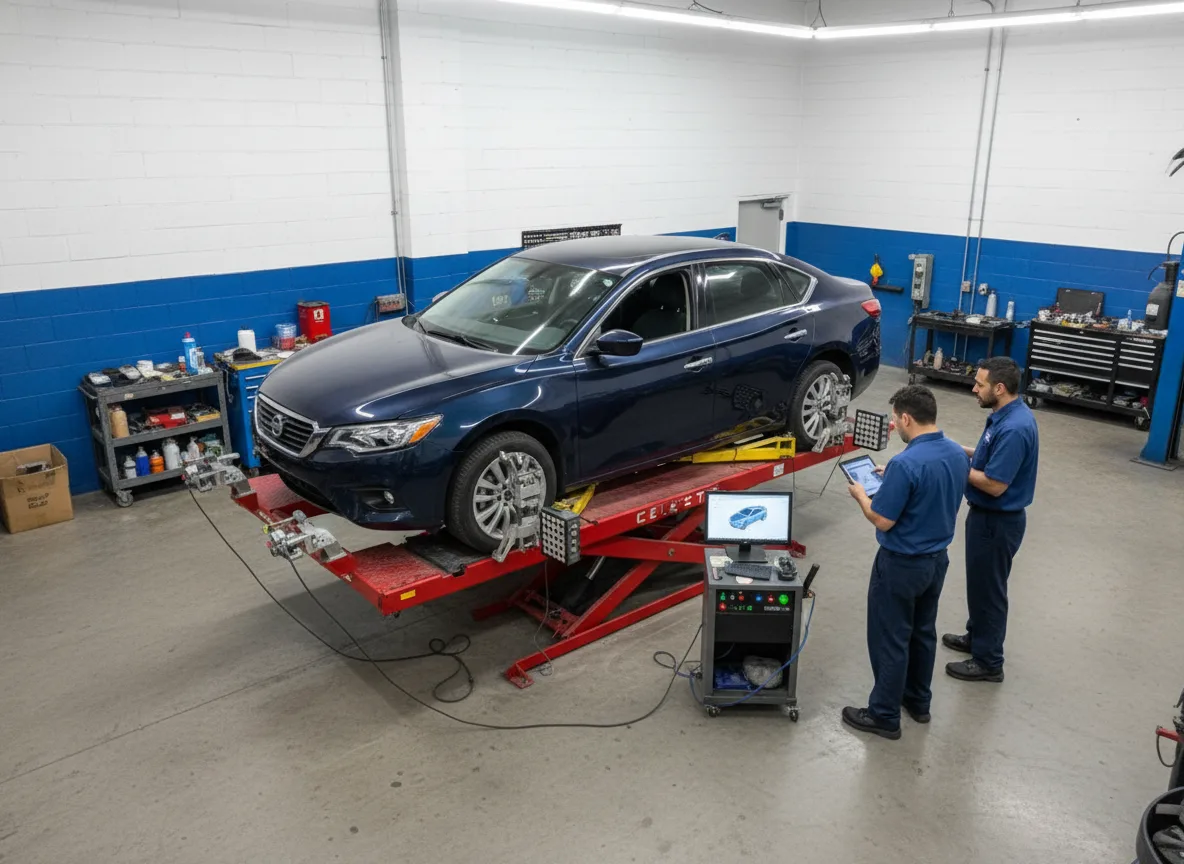
At ANA Auto Repair, we use computerized measuring systems that map your vehicle’s frame against manufacturer-specified tolerances. Every point on the chassis gets compared to the original factory blueprint, not to what looks straight on the lift.
What Laser Measurement Actually Does
The system works by attaching precision targets to reference points on the frame, then running those measurements through software that identifies exactly where deviations exist and by how much. It’s not just about finding the obvious bends. It’s about catching the subtle shifts that happen when impact energy distributes through the structure in ways that aren’t visible from the outside.
Once the damage is mapped, our technicians use a hydraulic frame straightening rack to apply controlled, measured force. The equipment pulls or pushes the frame back into spec while the measurement system monitors movement in real time. You’re not guessing. You’re watching the numbers change until they match the factory data.
Why This Matters for Richmond Hill Drivers
Drivers in Richmond Hill, Queens deal with a lot of stop-and-go traffic on Woodhaven Boulevard and the surrounding streets. That kind of daily driving puts consistent load on your suspension and steering. A frame that’s even slightly out of alignment will wear components faster and handle differently under braking. You may not feel it right away, but you’ll feel it eventually.
As a certified collision repair center, we follow I-CAR repair procedures and use OEM-referenced data for every frame job we take on. Our I-CAR certifications and aluminum welding credentials mean our technicians are trained specifically on the repair methods that vehicle manufacturers actually require.
Precision takes time. Some shops rush the straightening process to move vehicles faster, and that’s where problems get buried rather than fixed. We’d rather take the extra time to verify the numbers than hand a car back that looks repaired but isn’t. Reach out to schedule a frame assessment and get a same-day written estimate.
Common Frame Damage Patterns and What They Mean
Every collision tells a story in metal. After thirty years of pulling damaged vehicles onto the alignment rack, you start reading that story the moment a car rolls in.
Drivers in Richmond Hill bring us vehicles with damage that runs the full spectrum, but certain patterns repeat. Here’s what those patterns actually indicate about structural integrity:
-
Sideswiping along Woodhaven Boulevard or Cross Bay Boulevard: These typically produce lateral rail damage on one side. The hit looks cosmetic from the outside, but the inner rocker panel and floor structure often absorb significant force. A simple dent repair misses what’s underneath.
-
Rear-end impacts: The collision energy travels forward through the unibody. Trunk misalignment is the obvious symptom. What matters more is whether that energy reached the rear suspension mounts or kicked the subframe out of position.
-
Head-on or front-corner impacts: These are the most structurally complex. Crumple zones do their job by design, absorbing force through controlled deformation. But when the damage exceeds what the crumple zone was built to handle, the main frame rails and firewall take the load.
-
Diagonal or offset impacts: A common pattern in parking lot and intersection collisions. The vehicle twists rather than compresses. Diagonal damage is harder to catch without computerized measuring, which is exactly why three-dimensional frame analysis isn’t optional at a legitimate certified collision repair center.
One opinion worth stating plainly: visible damage is a poor guide to structural severity. A crumpled hood can come from a low-energy impact that left the frame untouched. A clean-looking quarter panel can hide a twisted rear rail. Trusting appearances is where bad repairs start.
Proper diagnosis requires equipment and trained eyes. That combination is what separates thorough repair from a cosmetic patch job that fails you later.
The Mistakes That Cost You Later: Incomplete Frame Repairs
Cutting corners on frame repair doesn’t show up immediately. It shows up six months later when your tires are wearing unevenly, your car drifts in a straight line, or a door suddenly stops latching right. By then, you’ve already paid once for the repair.
The three places where shops most commonly take shortcuts are surface preparation, secondary damage assessment, and post-repair alignment verification. Any one of them left undone can undo an otherwise acceptable repair.
Surface Prep Gets Skipped More Than You’d Think
Proper corrosion protection and surface prep before welding or straightening isn’t glamorous work. It’s also not billable time that a customer can see or photograph. So some shops rush it. The result is rust that develops beneath a fresh repair, weakening the metal over time in a spot that was supposed to be structurally sound again.
The Damage You Don’t See Is Often the Damage That Matters
A front-end collision that buckles one rail almost always transfers force to adjacent components. Firewall distortion, subframe misalignment, suspension mounting points that are slightly off. A shop focused on the obvious damage can miss the secondary damage entirely. This is where thirty years of reading collision patterns actually matters. Our team at ANA Auto Repair approaches every repair with a full structural assessment, not just the visible damage zone.
Skipping the Final Alignment Check Is a Real Problem
This one surprises people. A shop straightens the frame, welds what needs welding, and sends the car out without running a final four-wheel alignment check. The frame may be within spec. The alignment may still be off. Those are two different measurements, and both need to pass before a vehicle should leave the shop.
Drivers coming to us from Richmond Hill, Queens deserve repairs done completely, not just repaired enough to look finished. If you want to confirm what a thorough frame repair actually involves, reach out for a same-day estimate. A certified collision repair center should be able to walk you through every step, in writing, before the work begins.
Safety Systems Recalibration: The Step That Can’t Be Skipped
Most shops complete the frame work, do a wheel alignment, and call the job done. That used to be acceptable. It isn’t anymore.
Today’s vehicles run advanced driver assistance systems including lane-keeping assist, automatic emergency braking, blind-spot monitoring, and adaptive cruise control. These systems depend on sensors and cameras that are calibrated to precise tolerances. Frame damage shifts those tolerances. So does the repair work itself, even when that repair is done correctly.
Here’s the part that surprises a lot of drivers: a vehicle can come off the alignment rack with perfect measurements and still have a forward-collision sensor pointing slightly off-axis. The car drives straight. The frame checks out. But the automatic emergency braking is now reacting late or not at all, and the driver has no idea.
This is one of the most commonly missed steps in collision repair across the industry. We’ve seen vehicles come to us from Richmond Hill and surrounding areas after frame work was done elsewhere, with ADAS systems that were never recalibrated. The previous shop simply didn’t have the equipment or the protocol.
At ANA Auto Repair, ADAS recalibration is part of the repair process, not an optional add-on. As a certified collision repair center, we have the diagnostic capability to verify that every safety system is functioning within manufacturer specifications before a vehicle leaves our facility. You can review the full scope of what we handle on our services page.
A structurally sound vehicle with miscalibrated safety systems is still a safety risk. The frame repair isn’t finished until the electronics confirm it.
Choosing a Certified Collision Repair Center: What Sets ANA Auto Repair Apart
Not every shop with a spray gun and a frame machine is qualified to work on your car. That’s a blunt way to put it, but after thirty years in this business, it’s the truth.
ANA Auto Repair holds I-CAR Gold Class certification, which is the collision industry’s most recognized training standard. We’re also an I-CAR certified aluminum welding center, which matters more every year as manufacturers shift toward aluminum-intensive construction. These aren’t credentials we framed on a wall and forgot about. Maintaining them requires ongoing training as vehicles and repair methods evolve.
We’re based in South Ozone Park and proudly serve drivers throughout Richmond Hill, Queens. The distance is short, and the commitment to quality is identical regardless of where you’re coming from.
Insurance certifications matter too. ANA carries Geico Xpress and Allstate Good Hands designations, which simplify the claims process considerably. A lot of people assume they have to use whatever shop their insurer recommends. You don’t. You have the right to choose your own certified collision repair center, and your insurer is required to work with them. We help Richmond Hill customers navigate that process without the runaround.
What to Verify Before You Commit to Any Shop
Before you hand over your keys, do this:
-
Ask for written proof of I-CAR or ASE certification, not just a verbal claim.
-
Request a written estimate with line items. If a shop won’t put it in writing, walk away.
-
Ask specifically about the warranty on frame and structural work.
-
Confirm they perform post-repair alignment checks and ADAS recalibration where applicable.
-
Check whether they use OEM or aftermarket parts, and get that in writing too.
One opinion worth sharing: a suspiciously low estimate is almost always a warning sign, not a deal. Shops that underbid are usually planning to cut corners somewhere, and frame repair is exactly where those shortcuts cause the most harm down the road.
Explore our full list of services or reach out directly to request a same-day estimate. We’re ready to help.
Frequently Asked Questions
How do I know if my vehicle has frame damage after a collision?
Some signs are visible, like doors or windows that don’t close properly, uneven gaps between body panels, or the car pulling to one side while you’re driving. But a lot of frame damage hides beneath the surface where you simply can’t see it. At our certified collision repair center in Richmond Hill, Queens, NY, we use laser alignment equipment to run a thorough diagnostic scan. That’s the only reliable way to know for sure what you’re dealing with.
Can frame damage be repaired, or will my car be totaled?
In most cases, yes, frame damage can be repaired successfully, especially when it’s caught early and handled by a certified collision repair center. Whether your car is repairable or totaled comes down to the extent of the damage, the vehicle’s current value, and what your insurance policy covers. At ANA Auto Repair in Richmond Hill, Queens, NY, we provide detailed damage assessments so you understand exactly what your options are before any decisions get made.
Why does frame alignment require specialized equipment?
Modern vehicle frames are built to very precise tolerances. Even a small misalignment can affect your handling, braking, and safety system performance in ways you might not notice right away. We use laser measurement systems and computerized alignment racks to bring your vehicle back to factory specifications. This isn’t just about how the car drives. It also matters for your safety and the vehicle’s resale value down the road.
What is ADAS recalibration and why is it important after frame repair?
ADAS stands for Advanced Driver Assistance Systems. This includes features like lane-keeping assist, automatic emergency braking, and blind-spot monitoring. These systems depend on sensors being positioned at exact angles. If your frame or suspension has shifted, those sensors are off too, and the safety features won’t work the way they’re supposed to. After frame repair, recalibration resets everything back to factory specs so you can trust those systems again when you get back on the road.
How long does frame repair typically take?
It depends on how much damage there is, whether parts need to be ordered, and how quickly insurance approval comes through. A straightforward frame straightening job might take 3 to 5 days. More extensive structural repairs can run 2 to 3 weeks. When you bring your vehicle into ANA Auto Repair, we’ll give you a same-day estimate and keep you updated throughout the entire process so you’re never left guessing where things stand.
Get Your Frame Inspected Today at ANA Auto Repair in Richmond Hill, Queens, NY
If your vehicle has been in a collision, you don’t want to put off a frame inspection. Our I-CAR certified technicians will assess the damage and get you a same-day estimate, and we’re happy to help you work through the insurance claim process as well. Stop by ANA Auto Repair or give us a call, and check out our reviews on Google to see why drivers across Queens trust us with their vehicles.
Contact us now to schedule your frame damage diagnostic. We’re ready to help you get back on the road safely.